
Economic cooperations: Steps Toward Industrial Diversification and Improved Quality of Life in Botswana "A 50-Year History of Japan-Botswana Cooperation"
2026/4/1
About 50 years ago, Japan began accepting trainees in the telecommunications field in 1977, and Japan has been implementing cooperation in response to Botswana's needs. Industrial diversification is an urgent issue, as Botswana relies on diamonds and other mineral resources for much of its income. There are also challenges to people's quality of life, such as income inequality, quality of social services, and environmental degradation due to climate change and rapid urbanization. Under these circumstances, in the 1980s~1990s, we focused on the development of large-scale infrastructure such as electricity, roads, and water, and from the 2010s to the present day, we have been implementing projects in various fields with the diversification of industries and the improvement of the quality of life as the basic policy of cooperation with Botswana. The following are examples of cooperation in Official Development Assistance (ODA) loan and technical cooperation for the industrial diversification.
・Infrastructure Development to Support Industrial Diversification
With regard to the development of large-scale infrastructure that serves as the foundation of industry, we contributed to strengthening of the foundation for industrial diversification by implementing the Morupule Power Station Expansion Project in 1985, the Railway Rolling Stock Increase Project (1988), the Trans-Kalahari Road Project (1993), and the North-South Carrier Water Project (1995) through ODA loan.
In the field of information and communication, in response to the Botswana government's adoption of the Japanese method of terrestrial digital broadcasting, we supported the production of programs that support terrestrial digital through the "Digital Migration Project (2014~2016)". In addition, in order to spread terrestrial digital throughout the country, experts were dispatched to support the formulation of a nationwide analog switch off strategy, as well as awareness raising activities from 2017~2022, then Botswana became the first country to fully transition to terrestrial digital with the Japanese system.
As a cooperation with an eye on economic development in Southern Africa, beyond Botswana alone, the "Kazungula Bridge Construction Project" can be mentioned. The Kazungula is located on both sides of the Zambezi River, which separates Botswana from Zambia, and is located on an important north-south corridor in the Southern African region. With its completion in 2021, cargo and people, which previously required considerable time to travel on ferries with limited transport capacity, have been able to cross the border smoothly without delay. The Kazungula Bridge can be said to be a flagship project of cooperation with Botswana, to the extent that the President's State of Nation Address in November 2024 expressed his gratitude to Japan.
The Kazungula border is the first in Botswana to introduce a "One-Stop Border Post: OSBP" which allows customs clearance and immigration procedures of both countries to be conducted at a single location. In the technical cooperation project " Project for Capacity Development on Smooth Operation of OSBPs on the North-South Transport Corridor (2020~2025)", we supported the capacity building and manual development of border facilities staff, mainly Botswana Unified Revenue Service (BURS) officials, to ensure the functioning of OSBP. BURS is working to improve border control across the country, by transferring staff strengthened by the project to other borders, such as the one with Namibia.
In recent infrastructure support, we have been dispatching experts to support the development of institutional and organizational structures to promote the adoption of renewable energy through private investment in 2024 to meet the Botswana government's goal of increasing the proportion of renewable energy.
・Specific Initiatives to Promote Industrial Diversification
Specific industries to break away from diamond dependence include tourism, agriculture, and manufacturing. In the field of tourism, we have dispatched tourism advisors (2024~2026) to develop tourism products in areas other than Chobe National Park, which is Botswana's golden tourist route, aiming for a new tourist golden route, and improve tourism statistics.
In addition, in order to improve the situation where many agricultural products depend on imports from foreign countries such as South Africa, We are supporting the introduction of the SHEP approach introduced by JICA in African countries (which aims to increase farmers' horticultural income by improving farming and cultivation skills by causing a change in awareness from "grow and sell" to "grow to sell"). In the agricultural field, we have accepted 26 Botswana participants in Japan from 2019 to 2025, and we plan to cooperate with them with greater emphasis than ever before.
In addition, in response to the situation where the manufacturing industry is not sufficiently developed, we are conducting a survey to implement loan assistance to promote small and medium-sized enterprises (SMEs), through financing to SMEs.
・Balancing Industrial Diversification and Environmental Conservation
Environmental conservation is one of the important issues for Botswana's wildlife-based tourism. Forests, which account for 20% of the country's land, are not only home to diverse ecosystems and many rare species, but also a valuable source of income for local people due to their useful plants.
Following the Project for Enhancing National Forest Monitoring System for the Promotion of Sustainable Natural Resource Management (2013~2017), which was implemented to support the development of statistical data on forest resources, we implemented "The Capacity Enhancement Project for Capacity Development for the Conservation and Sustainable Use of Forest and Range Resources through the Process of Master Plan Development (2021~2025)" as a culmination of cooperation in the forest field based on the data developed through the previous project. In this project, we worked to strengthen the capacity of our counterpart, the Department of Forest and Range Resources (DFRR), through nine pilot projects throughout Botswana, including ecotourism and the pilot introduction of long-root seedlings, while formulating a draft master plan to strengthen the sustainable management of forest and grassland resources.
・Infrastructure Development to Support Industrial Diversification
With regard to the development of large-scale infrastructure that serves as the foundation of industry, we contributed to strengthening of the foundation for industrial diversification by implementing the Morupule Power Station Expansion Project in 1985, the Railway Rolling Stock Increase Project (1988), the Trans-Kalahari Road Project (1993), and the North-South Carrier Water Project (1995) through ODA loan.
In the field of information and communication, in response to the Botswana government's adoption of the Japanese method of terrestrial digital broadcasting, we supported the production of programs that support terrestrial digital through the "Digital Migration Project (2014~2016)". In addition, in order to spread terrestrial digital throughout the country, experts were dispatched to support the formulation of a nationwide analog switch off strategy, as well as awareness raising activities from 2017~2022, then Botswana became the first country to fully transition to terrestrial digital with the Japanese system.
As a cooperation with an eye on economic development in Southern Africa, beyond Botswana alone, the "Kazungula Bridge Construction Project" can be mentioned. The Kazungula is located on both sides of the Zambezi River, which separates Botswana from Zambia, and is located on an important north-south corridor in the Southern African region. With its completion in 2021, cargo and people, which previously required considerable time to travel on ferries with limited transport capacity, have been able to cross the border smoothly without delay. The Kazungula Bridge can be said to be a flagship project of cooperation with Botswana, to the extent that the President's State of Nation Address in November 2024 expressed his gratitude to Japan.
The Kazungula border is the first in Botswana to introduce a "One-Stop Border Post: OSBP" which allows customs clearance and immigration procedures of both countries to be conducted at a single location. In the technical cooperation project " Project for Capacity Development on Smooth Operation of OSBPs on the North-South Transport Corridor (2020~2025)", we supported the capacity building and manual development of border facilities staff, mainly Botswana Unified Revenue Service (BURS) officials, to ensure the functioning of OSBP. BURS is working to improve border control across the country, by transferring staff strengthened by the project to other borders, such as the one with Namibia.
In recent infrastructure support, we have been dispatching experts to support the development of institutional and organizational structures to promote the adoption of renewable energy through private investment in 2024 to meet the Botswana government's goal of increasing the proportion of renewable energy.
・Specific Initiatives to Promote Industrial Diversification
Specific industries to break away from diamond dependence include tourism, agriculture, and manufacturing. In the field of tourism, we have dispatched tourism advisors (2024~2026) to develop tourism products in areas other than Chobe National Park, which is Botswana's golden tourist route, aiming for a new tourist golden route, and improve tourism statistics.
In addition, in order to improve the situation where many agricultural products depend on imports from foreign countries such as South Africa, We are supporting the introduction of the SHEP approach introduced by JICA in African countries (which aims to increase farmers' horticultural income by improving farming and cultivation skills by causing a change in awareness from "grow and sell" to "grow to sell"). In the agricultural field, we have accepted 26 Botswana participants in Japan from 2019 to 2025, and we plan to cooperate with them with greater emphasis than ever before.
In addition, in response to the situation where the manufacturing industry is not sufficiently developed, we are conducting a survey to implement loan assistance to promote small and medium-sized enterprises (SMEs), through financing to SMEs.
・Balancing Industrial Diversification and Environmental Conservation
Environmental conservation is one of the important issues for Botswana's wildlife-based tourism. Forests, which account for 20% of the country's land, are not only home to diverse ecosystems and many rare species, but also a valuable source of income for local people due to their useful plants.
Following the Project for Enhancing National Forest Monitoring System for the Promotion of Sustainable Natural Resource Management (2013~2017), which was implemented to support the development of statistical data on forest resources, we implemented "The Capacity Enhancement Project for Capacity Development for the Conservation and Sustainable Use of Forest and Range Resources through the Process of Master Plan Development (2021~2025)" as a culmination of cooperation in the forest field based on the data developed through the previous project. In this project, we worked to strengthen the capacity of our counterpart, the Department of Forest and Range Resources (DFRR), through nine pilot projects throughout Botswana, including ecotourism and the pilot introduction of long-root seedlings, while formulating a draft master plan to strengthen the sustainable management of forest and grassland resources.

PHOTO(1) Morupule A Power Station in operation since 1989
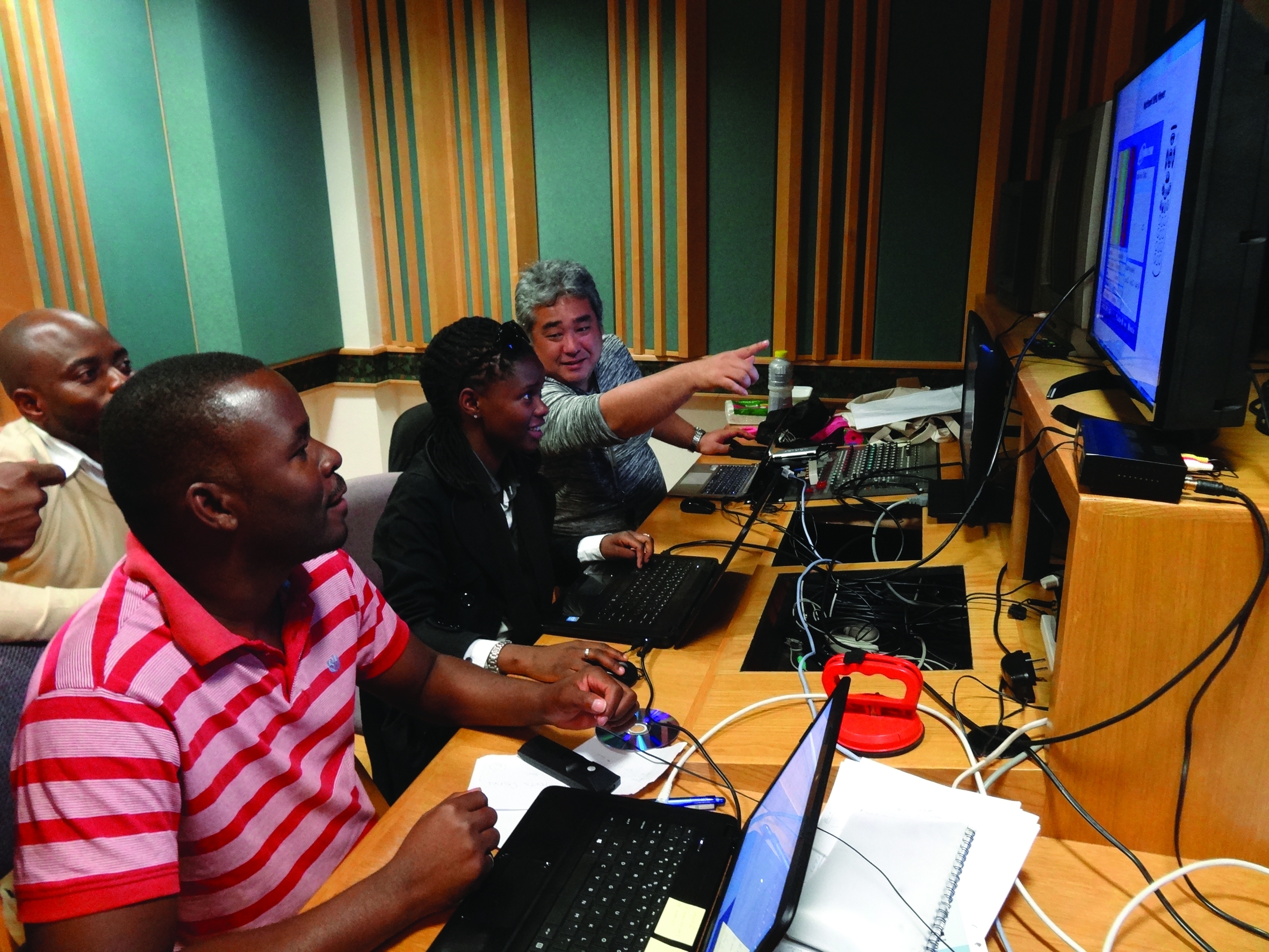
PHOTO(2) JICA Experts who teach broadcast production techniques for terrestrial digital broadcasting

PHOTO(3) The ferry terminal used in the past and the Kazungula Bridge

PHOTO(4) Passenger terminal that enables immigration procedures in one place by introducing OSBP

PHOTO(5) JICA Expert explaining the signage for tourists designed by Japan Overseas Cooperation Volunteer (JOCV)
Recommended Information
- GGP: Beneficiaries Interview at Marulamantsi Community Junior Secondary School
- Message from a JOCV: "Surrounded by Nature, Wildlife, and Peace" | Community development volunteer, KANNO Yuya
- Message from a former JOCV: "It turned out they were a former host family..." |Mr. UEMURA Yoshihiro (Principal Consultant, OPMAC Corporation)
- JICA long-term trainee's message: Ms Tshwarelo Mocheko, Assistant Director under the Directorate of Public Service Management (DPSM)